
Buyer guide
TR90 vs PC vs Metal Frames: What B2B Buyers Should Know
Frame material decides your unit cost, your return rate and how your product feels in the hand. This guide compares TR90, polycarbonate and metal frames on the properties that matter to a purchase order — and explains which material belongs at which price point.
A customer cannot see the frame material on a shelf, but they can feel it in ten seconds. Weight, flexibility and the way a temple flexes are the first quality signals a buyer registers. Frame material is therefore both a cost decision and a returns decision, and it is usually the first thing to get wrong.
This guide compares the three material families used across almost all sport sunglasses and explains how to specify them in a purchase order.
1. Why frame material is a margin and returns decision
Two frames can look identical and behave completely differently. The material sets:
- Weight — which determines comfort on a long ride or a full day on the water.
- Flexibility and memory — whether the frame springs back into shape or stays bent.
- Impact behaviour — how the frame responds to a drop, a crush in a bag or an impact during sport.
- Retail adjustability — whether a shop can bend the temple to fit a customer in-store.
- Finishing options — the colours and surface effects that are possible.
- Compliance exposure — metal parts in prolonged skin contact bring nickel-release obligations in some markets.
2. TR90: the default sport frame material
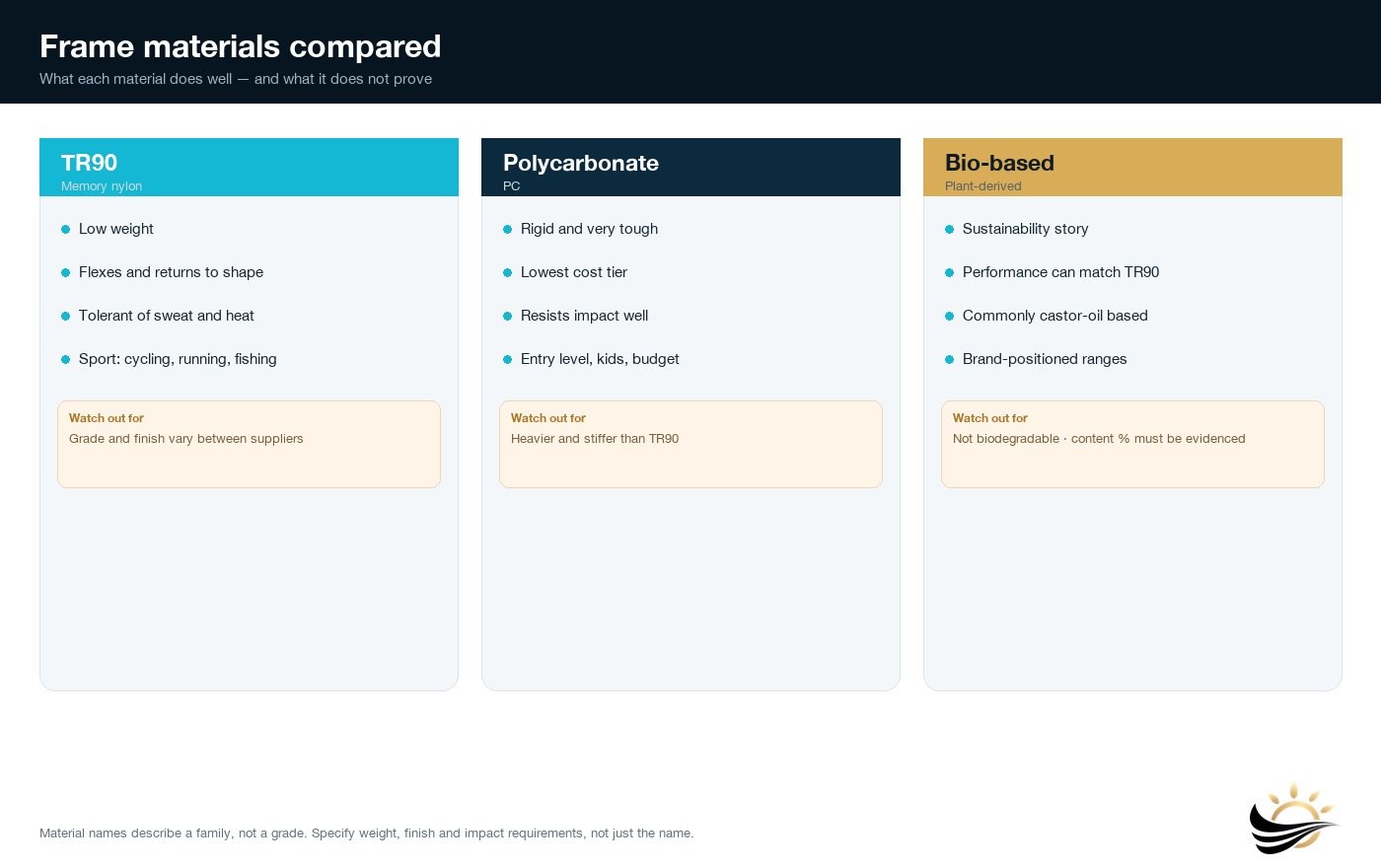
TR90 is a thermoplastic polyamide (nylon-based) material with shape memory. It is the most common choice for sport and kids frames, and for good reasons.
- Light — density of roughly 1.14 g/cm3, so a moulded frame is significantly lighter than an equivalent metal frame.
- Flexible with memory — it bends under load and returns, which is why TR90 frames survive being sat on better than rigid plastics.
- Impact and sweat resistant — it tolerates the oils and salt in sweat without the corrosion issues of metal.
- Wide colour range — matt, gloss, translucent and soft-touch finishes are all achievable.
Limitations: TR90 cannot be heat-adjusted at retail the way metal can, so fit has to be right at the design stage. Very thin sections are difficult, so TR90 frames tend to look slightly thicker than metal. Premium hand-feel is harder to achieve than with acetate or titanium.
3. Polycarbonate (PC): stiffer and cheaper
Polycarbonate is used for both lenses and frames. As a frame material it is rigid, inexpensive and easy to mould in high volumes.
- Low material cost — good for opening price points and promotional orders.
- Very high impact resistance — the same property that makes PC the standard lens material.
- Tight tolerances — holds moulded detail well, including logos.
Limitations: PC frames are stiffer and have no memory, so they crack rather than flex under repeated stress. They are also more sensitive to some solvents and to certain sunscreen formulations, which can cause stress cracking around the hinge and lens groove. For a sport frame that will be flexed on and off, TR90 is usually the better wear experience at a small cost premium.
4. Metal: stainless steel, aluminium and titanium
Metal frames are chosen for a slimmer profile, a premium look and retail adjustability.
- Stainless steel — the workhorse. Durable, adjustable, and available in thin profiles. Heavier than TR90.
- Aluminium — light and modern, but softer, so it dents and deforms more easily and needs careful hinge design.
- Titanium — the lightest and most corrosion-resistant option, with the best strength-to-weight ratio and the highest cost.
Compliance note: metal components that sit against the skin for prolonged periods can fall under nickel-release limits in the EU and similar markets. Ask for the nickel-release test on the specific alloy and finish, not a general materials certificate. Coatings and surface treatments vary, so the test has to cover the finished part.
5. Side-by-side comparison
| Property | TR90 | Polycarbonate | Metal |
|---|---|---|---|
| Density (approx.) | 1.14 g/cm3 | 1.20 g/cm3 | 2.7 (Al) to 8.0 (steel) g/cm3 |
| Flexibility / memory | High — springs back | Low — stiff | Low to moderate, depending on design |
| Impact behaviour | Absorbs and recovers | Very high, but cracks under repeated flex | Dents or bends permanently |
| Retail adjustment | Not heat-adjustable | Not adjustable | Adjustable at the temple |
| Corrosion / sweat | Excellent | Good, solvent-sensitive | Requires coating; nickel release applies |
| Finish options | Very wide, including translucent | Wide | Plating, anodising, PVD |
| Tooling cost | Moderate | Moderate | Higher — multiple metal dies |
| Typical position | Sport and performance | Entry and promotional | Premium and lifestyle |
6. Match material to channel and price point
| Channel or price tier | Sensible default |
|---|---|
| Promotional, giveaway, entry e-commerce | Polycarbonate frame, TAC lens |
| Sport performance, cycling, running, fishing | TR90 frame, polarized or photochromic lens |
| Premium retail and lifestyle | Metal or titanium frame, nylon polarized lens |
| Kids and junior | TR90, with rounded geometry and no sharp edges |
7. What to write in the purchase order
- Material grade, not just the trade name — and whether recycled or bio-based content is required.
- Frame colour with a Pantone or approved physical swatch, not a screen colour.
- Finish: matt, gloss, soft-touch or translucent, with the gloss level referenced to the golden sample.
- Flex requirement for TR90, and a bend test in the inspection plan.
- Temple length, nose bridge width and lens height, with tolerances.
- Nickel-release and material test reports where metal parts touch the skin.
- Hinge type and cycle-test requirement, since the hinge is the most common point of failure.
Choosing a frame platform?
Tell us your price point, target channel and lens plan. We will recommend the frame material that fits, and quote the platforms that support it.
Request a Quote Browse frames by categoryLet’s Work Together
Specifying a Frame Material?
We supply TR90, polycarbonate, bio-based and floating-material platforms from a vetted partner network. Send your price point and channel and we will match the material to it.