
Buyer guide
Pickleball Glasses: What to Look For
Pickleball eyes are exposed to a hard ball at close range, and the sport moves between indoor courts and full sun. This guide covers lens choice, fit, impact protection, and what to check before you buy for a club or a reseller.
Most players start by buying a pair of sunglasses and quickly find they are wrong for half their games. The court is too dark under floodlights. The tint is wrong when the sun comes over the fence. The frame slides on a hard stop. Pickleball eyewear is a lighting problem first and a fashion problem second, and that is why the range that works is built around interchangeable lenses rather than a single pair.
Why pickleball needs its own eyewear
Three things set pickleball apart from other racket sports. The ball is perforated plastic but travels fast from a short distance, especially at the kitchen line. The court surface is often a coloured acrylic that throws glare upward. And the sport is played indoors and outdoors by the same people in the same week.
The result is that a single fixed tint rarely fits. An indoor session under artificial light needs contrast, not darkness. An outdoor session at midday needs glare control. A late-afternoon game needs something in between.

The three lighting conditions, and the lens for each
Indoor courts and floodlit play. Yellow or amber. It raises contrast against a dark background without reducing the light reaching your eyes, which is the opposite of what a dark tint does indoors.
Bright outdoor courts. Smoke or grey. It lowers overall light transmission evenly, so colours stay accurate and the ball stays visible against the surface.
Club play, coaching and beginners. Clear. Protection without tint, and no adjustment period when moving between courts.
If a player wants one pair rather than a kit, photochromic lenses darken automatically in UV light and return to clear indoors. They cost more than a fixed tint but less than maintaining two pairs.
Lens options compared
The range we supply covers five lens types on the same TR90 frame platform:
Polycarbonate clear — impact-resistant, no tint, the baseline for protection.
Polycarbonate yellow — contrast boost for indoor and low light.
Polycarbonate smoke — glare reduction for bright outdoor courts.
Photochromic — automatically adjusts between indoor and outdoor.
TAC polarized — cuts reflected glare off the court surface. Best used outdoors; unnecessary indoors.
Every lens in the range is UV400, and every model is supplied as a kit with interchangeable lenses rather than a single fixed lens.
Frame and fit
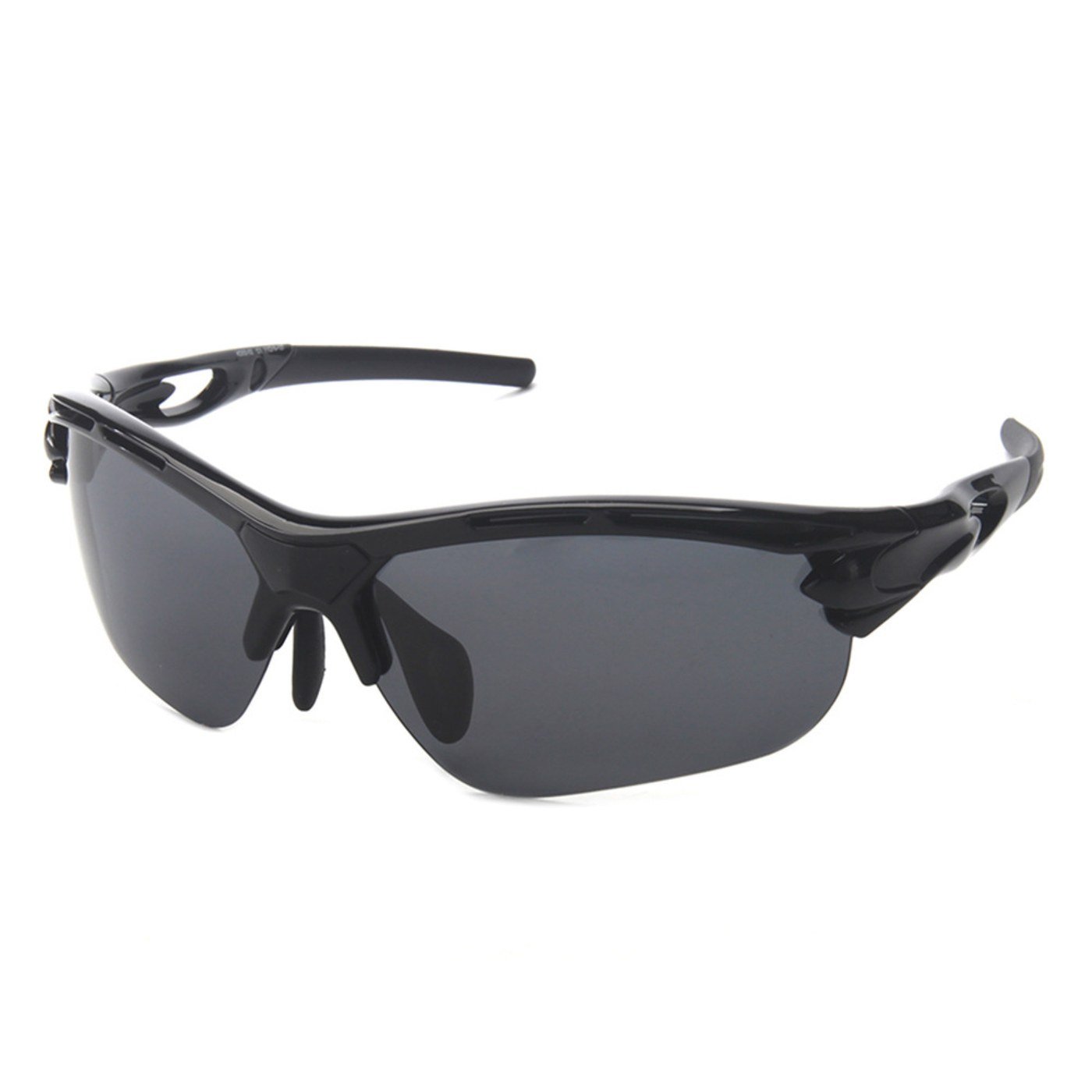
Two details decide whether a frame stays on during play. The nose pad is the first: an anti-slip pad gives a fixed, low-maintenance fit, while an adjustable pad lets one frame fit a wider range of faces. The second is frame width, which in this range runs from 69 mm to 145 mm.
Narrower models suit smaller faces and work well as a women’s option. The wider models — around 135-145 mm — suit broader faces and can be positioned as unisex.
Impact protection and what to check
For ball sports, polycarbonate is the material to specify. It resists impact far better than glass or standard CR-39. Ask any supplier for the impact test position and confirm the lens is polycarbonate rather than acrylic.
For markets that regulate eye protection as PPE, check the classification before you order. Our certifications page lists the test reports available per range and per market.
Buying for a club or a reseller
Clubs usually want one frame with a full lens kit per player, plus spares. Resellers usually want a narrow colour range with the lens kit as the selling point.
Because the pickleball range shares tooling with our cycling and golf platforms, consolidation is straightforward: mix platforms in one order, and use one logo specification across all of them. Our ordering terms cover minimums and lead time.
MOQ, logo and packaging
Stock colourways with your logo start at 50 pcs per colour. Custom frame colours outside the stock range start at 600 pcs total across a maximum of two colours. Packaging — pouch, hard case, retail box, hang tag — is quoted separately and can be branded. See the pickleball range page for the models and their measurements.
FAQ
Which lens should I choose for indoor pickleball?
Yellow. It raises contrast under artificial light without darkening the court.
Do I need polarized lenses for pickleball?
Outdoors, polarized helps with glare off the court surface. Indoors it is unnecessary. TAC polarized is available on every model in the range.
Is one photochromic pair enough?
For many players yes — it covers indoor and outdoor play. It costs more than a fixed tint but less than two pairs.
Are these frames suitable for other racket sports?
Yes. The same TR90 platforms are used in our cycling and golf ranges.
Planning a pickleball range? Tell us the models, quantities and whether you need the lens kit in the box. We will come back with a quotation and a packing proposal.