
Materials & Lens Technology
TR90, PC and Bio-Based Frames
Distinguish a resin grade, a polymer family and a feedstock claim, then specify the finished frame rather than relying on a material label.
On this page
TR90 vs polycarbonate: the direct comparison
If you only need the answer, this is it. Both are injection-moulded thermoplastics; they are not interchangeable, and the right choice follows from what the frame has to survive.
| Dimension | TR90 (nylon-based) | Polycarbonate (PC) |
|---|---|---|
| Density | About 1.0–1.1 g/cm³ | About 1.2 g/cm³ |
| Weight in the hand | Lighter for the same wall thickness | Noticeably heavier |
| Impact resistance | Good, but it can crack under a hard point load | Excellent — the reason it is used for safety and high-impact sport |
| Feel and finish | Softer, slightly rubbery, takes a matte finish naturally | Hard and glossy; needs coating for a matte look |
| Flex and recovery | Flexes and returns; comfortable over long wear | Stiffer; less forgiving on fit |
| Heat resistance | Lower — deforms sooner in a hot car | Higher |
| Moisture sensitivity | Nylon absorbs moisture, which can shift dimensions | Low moisture uptake |
| Relative cost | Higher | Lower |
| Typical use | Long-wear sports, lifestyle, lightweight frames | Impact sports, safety eyewear, budget programmes |
Grade matters more than the family name. Two frames both labelled “TR90” can differ in impact performance depending on the resin grade and the wall design. Treat this table as the starting point for a specification, not a substitute for one.
Understand What Each Label Describes
TR90, polycarbonate and bio-based do not describe three mutually exclusive material families. TR90 points to a grade designation, polycarbonate identifies a polymer family, and bio-based describes feedstock origin. A bio-based frame may itself be a polyamide. Treating the labels as a simple good-better-best ladder hides the information a buyer needs.
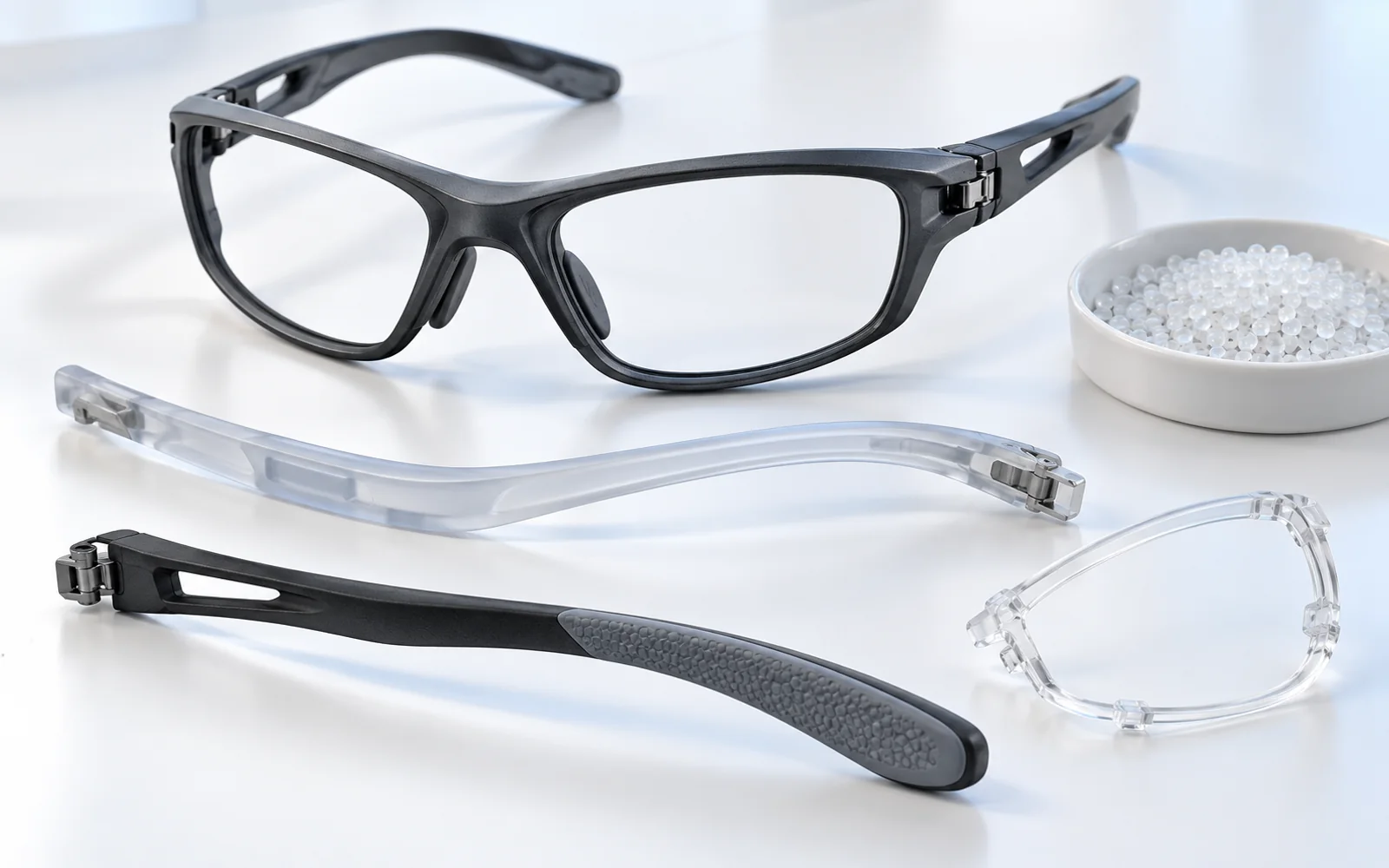
Begin with the proposed resin supplier, grade and technical datasheet. Then establish which components use it. A front, temple, nose pad and hinge may all have different materials. The frame’s comfort and durability depend on their geometry, processing, finish and assembly as well as the resin.
Specify TR90 Accurately
EMS-GRIVORY identifies Grilamid TR 90 within its transparent polyamide offering for optics. Its Grilamid TR information describes an amorphous thermoplastic range with low density and low moisture absorption. For the supplied frame, confirm resin provenance and assess mechanical performance against agreed finished-product criteria.
If a quotation says only ‘TR90’, ask whether it means the named EMS grade or a different proposed resin. Require a precise declaration rather than accepting an implied equivalence. Avoid treating ‘memory nylon’ as a promise that a frame will recover from any bending or survive indefinitely. The approved frame still needs defined mechanical and dimensional acceptance criteria.
Compare PC and Bio-Based Options Without Shortcuts
For polycarbonate, specify the frame resin independently of the lens resin. The same abbreviation on both components does not mean the same grade or processing conditions. Ask for the proposed grade’s data and assess the moulded frame, finish and hardware together. Do not assume every PC frame is painted, heavier than every polyamide frame, or sold at a particular price level.
For bio-based options, name the polymer first. Arkema identifies castor oil as the renewable feedstock for Rilsan PA11. Identify the resin used in each supplied frame component and obtain the corresponding feedstock declaration.
| Description | Information to request | Unsupported shortcut to avoid |
|---|---|---|
| TR90 | Named producer, exact grade and component scope | All similarly labelled frames have identical flexibility |
| Polycarbonate | Frame-grade datasheet, processing and finish specification | PC automatically establishes impact certification |
| Bio-based polyamide | Polymer identity, content measure and evidence for the supplied material | Plant-derived means biodegradable or lower-impact in every respect |
Compare weight and cost on the actual finished constructions and quotations, accounting for design, finish and production requirements.
Test the Finished Frame for Its Intended Exposure
Define a sample plan around the intended environment. Relevant checks may include temple movement, hinge operation, lens retention, fit after conditioning, decoration adhesion and contact with specified cleaning products or sunscreen. Agree the method and acceptable result before testing. A dramatic bending demonstration is not a substitute for a repeatable test.
Inspect the assembled product after exposure. A satisfactory resin result does not establish the durability of a painted finish, printed logo, screw or insert. Record whether the test used bare material, individual components or the complete frame, and whether the sample matches the proposed production configuration.
For metal hardware, ISO 9227:2022 describes salt-spray procedures, not a universal exposure duration or product pass criterion. Its public scope cautions against using the methods to rank different materials or predict long-term corrosion resistance. A salt-spray result must not be converted into a promised number of seasons at sea.
Put Boundaries Around Bio-Based Claims
A content claim needs a named component, measurement basis and supporting document. ISO 16620-2:2019 concerns biobased carbon content determined through radiocarbon measurement. A biobased-carbon percentage is not automatically a percentage of the whole product’s mass.
Ask whether the declaration concerns physical biobased content or an attributed feedstock claim under a chain-of-custody scheme. Preserve that distinction in the retail wording. Do not translate a resin declaration into a whole-product claim without checking lenses, grips, pigments, coatings and hardware.
| Proposed claim | Required clarification |
|---|---|
| Bio-based frame | Which parts, which polymer and which content measure? |
| Certified material | Which scheme, certificate holder, grade and permitted wording? |
| Recyclable product | Which collection and processing route accepts the finished assembly? |
| Reduced environmental impact | Compared with what baseline, over which lifecycle boundary? |
Bio-based origin alone establishes neither biodegradability nor practical recyclability. Keep these as separate claims requiring their own evidence.
Approve the Complete Frame Specification
Write the resin declaration, component list, colour and finish targets, hardware specification, approved sample and agreed test methods into the order documentation. Include a change-notification requirement for resin substitutions, mould changes, coatings and hardware. Recheck product claims when a material or construction changes.
Frame material does not establish the lens’s UV protection or the complete eyewear’s suitability for a mechanical hazard. Those require separate evidence matched to the intended product and market. Ask for the test scope rather than a general statement that a material is ‘certified’.
For a WORLUX enquiry, provide the intended sport, environment, finish, market and claim requirements. Availability must be confirmed for the selected configuration. Refer to ordering terms; the quotation confirms per-model and per-colour totals and the applicable production schedule.
Which one should you choose?
The specification follows from the use case. Work backwards from what the frame has to survive, not from the material name.
| If the product is… | Start with | Because |
|---|---|---|
| Cycling, running, or worn for hours at a time | TR90 | Weight and long-wear comfort matter more than maximum impact resistance |
| High-impact sport, or a safety-critical application | Polycarbonate | Impact resistance is the governing requirement, and cost is secondary |
| A budget or promotional programme | Polycarbonate | Material cost is lower and the finish tolerates a simpler coating |
| Premium or lifestyle, with a matte soft-touch finish | TR90 | The material takes a matte finish without a separate coating step |
| Sold into a market with a bio-based procurement requirement | Either, with evidence | The claim needs a documented feedstock percentage and a defined boundary, not a material choice |
| Used in high heat or left in a vehicle | Polycarbonate | Higher heat deflection temperature |
Two practical cautions. First, a frame can mix materials — a TR90 front with PC temples is common, and the comparison has to be made component by component. Second, both materials are specified by grade, and the grade decides performance more than the family name does.
Sources & Further Reading
- EMS-GRIVORY: Grilamid TR 90 in optics applications
- EMS-GRIVORY: Grilamid TR material family
- Arkema: Rilsan PA11 and castor-oil feedstock
- ISO: ISO 16620-2:2019, biobased carbon content scope
- ISO: ISO 9227:2022, salt-spray scope and limitations
Sources checked for this editorial update. Standards and market requirements can change; confirm the applicable edition and product-specific evidence before placing an order.