
Materials & Lens Technology
Eyewear Materials and Coatings Glossary
A buyer’s glossary separating materials, lens functions, surface treatments and construction features, with the evidence each term needs.
On this page
Read Terms by Their Purpose
An eyewear quotation may place TR90, polarized, UV400, mirror and magnetic in the same feature list. They answer different questions. Some identify a component material; some describe optical behaviour; others name a surface treatment or a mechanical feature. None describes the whole product on its own.
Use this glossary to turn a feature list into a specification. For every term, identify the component or surface, the intended function and the evidence needed. Confirm technology availability and supporting documentation for the specific WORLUX model and lens configuration.
Identify Component Materials
TR90: a designation associated with Grilamid TR 90 from EMS-GRIVORY, not a universal guarantee for any frame using similar trade wording. The manufacturer describes Grilamid TR as a transparent polyamide range. Ask for producer, exact grade and the components covered.
PC: polycarbonate. A PC frame and a PC lens need separate specifications; the abbreviation does not imply identical resin grades or impact certification. Nylon: polyamide, with the exact optical or structural grade still to be established.
Bio-based: a feedstock-origin description, not a polymer family or an end-of-life instruction. Arkema’s castor-oil-derived PA11 is one example. Request content basis and component scope rather than assuming the entire product has the same composition.
TAC: triacetate, commonly cellulose triacetate in eyewear terminology. TAC sheet polarized lenses are commercially available, but the abbreviation does not define all layers or finished-product performance. Acetate frame describes a frame material and should not be confused with a TAC lens. AC/demo lens needs clarification: a display insert is not automatically a protective sun lens suitable for sale as finished eyewear.
Distinguish Lens Functions
| Term | What it describes | What to confirm |
|---|---|---|
| VLT | Visible light transmission | Finished-lens measurement and the stated method |
| Filter category | A classification related to visible transmission | Applicable standard, boundaries, intended use and warnings |
| UV400 | A claim of UV protection extending to 400 nm | Measured wavelength coverage, limits and variant scope |
| Polarized | Selective filtering of light by polarization orientation | Performance, alignment and compatibility with relevant displays |
| Photochromic | Reversible light-dependent tint change | Light and dark states, response conditions and restrictions |
| Solid or gradient tint | Colour distribution through the viewing area | Approved appearance and measured transmission |
UV protection must not be inferred from darkness or polarization. The WHO wavelength definitions place the upper end of UVA at 400 nm; the label still needs a defined transmission basis. It is not an independent certification mark.
For photochromic lenses, specify response conditions as well as response time. Transitions explains that temperature can affect response. Request response data for the proposed lens under operating conditions relevant to the intended use.
Decode Coating Language
Surface treatments can be combined, but their architecture is product-specific. ZEISS lists distinct hard-coat, anti-reflective and mirror technologies. Use the names to identify functions, not to assume a fixed stack.
| Term | Intended function | Important limit |
|---|---|---|
| Hard coat | Improve resistance to surface abrasion | Scratch-resistant is not scratch-proof |
| AR | Reduce lens-surface reflection | Not the same as polarization or verified UV protection |
| Hydrophobic | Reduce water wetting and aid cleaning | Not proof of anti-fog performance |
| Oleophobic | Reduce oil wetting and aid cleaning | Not universal chemical resistance |
| Mirror / REVO wording | Describe a reflective finish or supplier finish name | Does not identify a common UV rating or standard recipe |
| Anti-fog | Delay or reduce visibility loss from condensation | Requires conditions, method and care instructions |
| Salt-water resistant | An exposure-related claim needing definition | Specify lens, decoration or hardware; no implied service life |
Record the treated surface and performance after agreed cleaning and exposure. A tick beside a coating name is not a durability criterion.
Define Construction and Fit Features
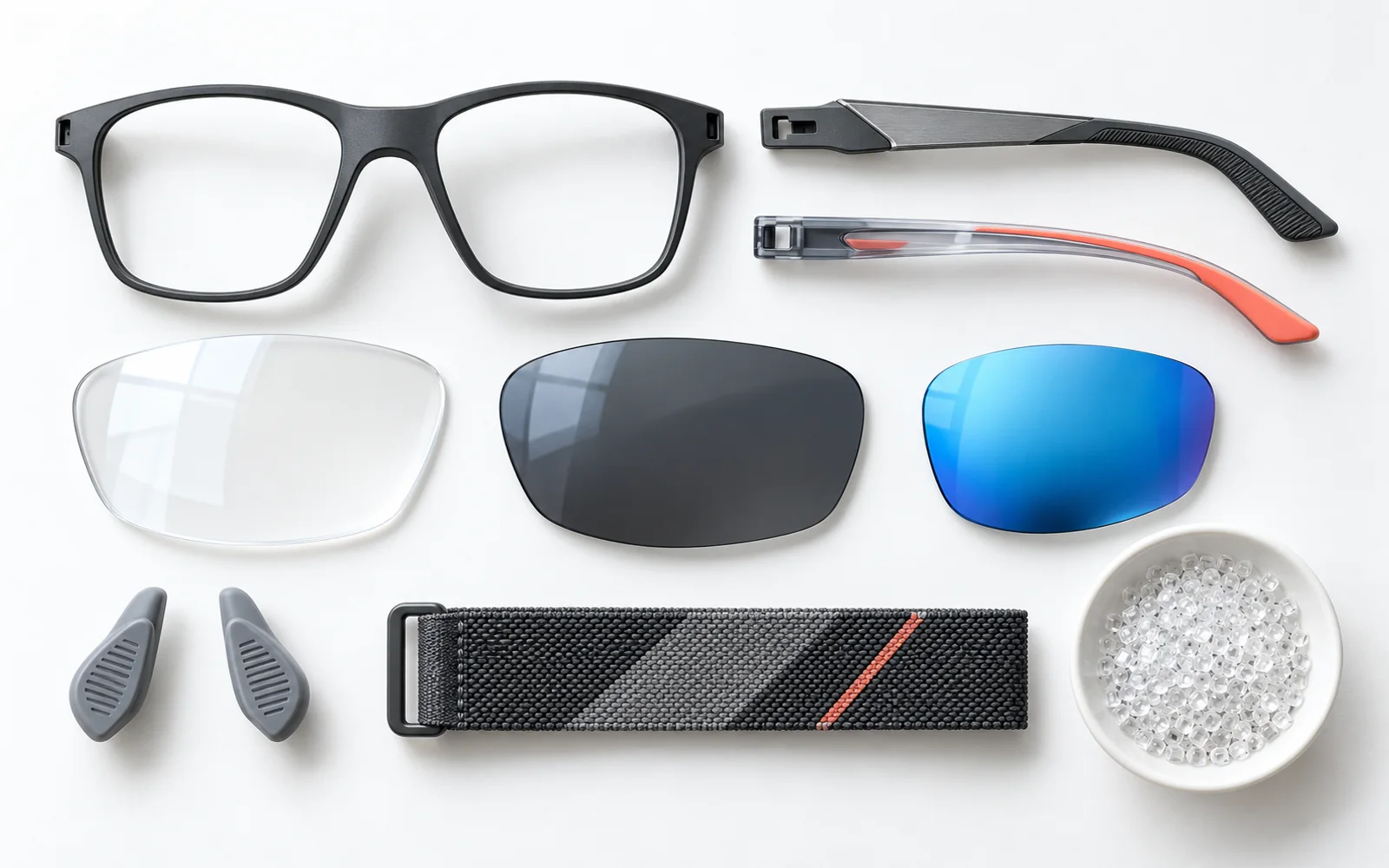
Shield: a broad, usually single-piece front lens form. Full-rim, semi-rimless and rimless: descriptions of lens support, not optical quality or protection ratings. Wrap: a description of curvature or coverage that needs dimensions and a fit check before comparison.
Interchangeable or magnetic: a lens-retention or exchange mechanism. Check correct installation, retention and replacement availability on the specific model. Magnets do not establish a protective rating. RX-ready or optical insert: prescription accommodation requiring model compatibility and professional fitting confirmation; it is not a promise that every prescription can be supplied.
Adjustable nose pads and temple grips: fitting features whose usefulness depends on contact points and the wearer. Assess them with the intended headwear and in the intended activity. A feature list cannot replace a practical sample evaluation.
Turn the Glossary Into an Order
Specify frame and lens materials, exact variant, surface treatments, measured optical properties, intended market and proposed claims. Link each claim to a report or declaration whose scope includes the ordered build. The public scope of ISO 12312-1:2022 is for general-use sunglasses, not every specific-sport protector.
Keep the approved sample, acceptance criteria and change-control requirements together. Review wording again if the supplier changes a resin, lens source, coating or retention component. For commercial requirements, consult ordering terms; the quotation confirms per-model and per-colour totals, configuration availability and the applicable schedule.
Sources & Further Reading
- EMS-GRIVORY: Grilamid TR transparent polyamide family
- Arkema: Rilsan PA11 feedstock example
- Japan Eyewear: TAC sheet polarized lenses
- WHO: Ultraviolet wavelength definitions
- Transitions: Photochromic FAQs and temperature considerations
- ZEISS: Coating technologies
- ISO: ISO 12312-1:2022 public scope
Sources checked for this editorial update. Standards and market requirements can change; confirm the applicable edition and product-specific evidence before placing an order.