
Materials & Lens Technology
Snow Goggle Lenses: S0-S4 and Beyond
Use measured transmission to specify a lens, then assess tint, coatings, construction and supporting evidence separately. A mirror finish is not a performance category.
On this page
Start With Measured Transmission
Visible light transmission, or VLT, is the familiar buying term for how much visible light a lens transmits. For snow goggles, ISO 18527-1:2021 is the relevant sport-specific starting point, rather than a general sunglasses standard. Its classification uses measured luminous transmittance with a defined illuminant and method.
A category is not a guarantee of terrain visibility, comfort or UV protection. Nor does an external mirror colour tell you the view through the lens. Specify the finished assembly and its lens code, not just a photograph or a marketing colour name. Different coatings on the same base tint can produce different transmission results.
The S0-S4 Category Bands
The nominal limits below follow Table 1 in the public ISO preview provided by SIST. The purchasing notes are selection prompts, not standard-defined weather ratings.
| Category | Nominal VLT | Purchasing note |
|---|---|---|
| S0 | More than 80%, up to 100% | Consider for very low light; confirm intended-use instructions. |
| S1 | More than 43%, up to 80% | A lighter filter to evaluate for low-light conditions. |
| S2 | More than 18%, up to 43% | An intermediate filter to evaluate for variable light. |
| S3 | More than 8%, up to 18% | A darker filter to evaluate for bright conditions. |
| S4 | More than 3%, up to 8% | A very dark filter requiring particular attention to use limitations. |
Boundary caution: apply the standard’s classification rules rather than rounding a catalogue figure into a category. Uniform and gradient tints have different overlap provisions, and no overlap is allowed between S3 and S4. Have the laboratory confirm the declared category and applicable rules. Nominally, 8% belongs to S4, not S3.
Tint, Mirror and UV Are Separate
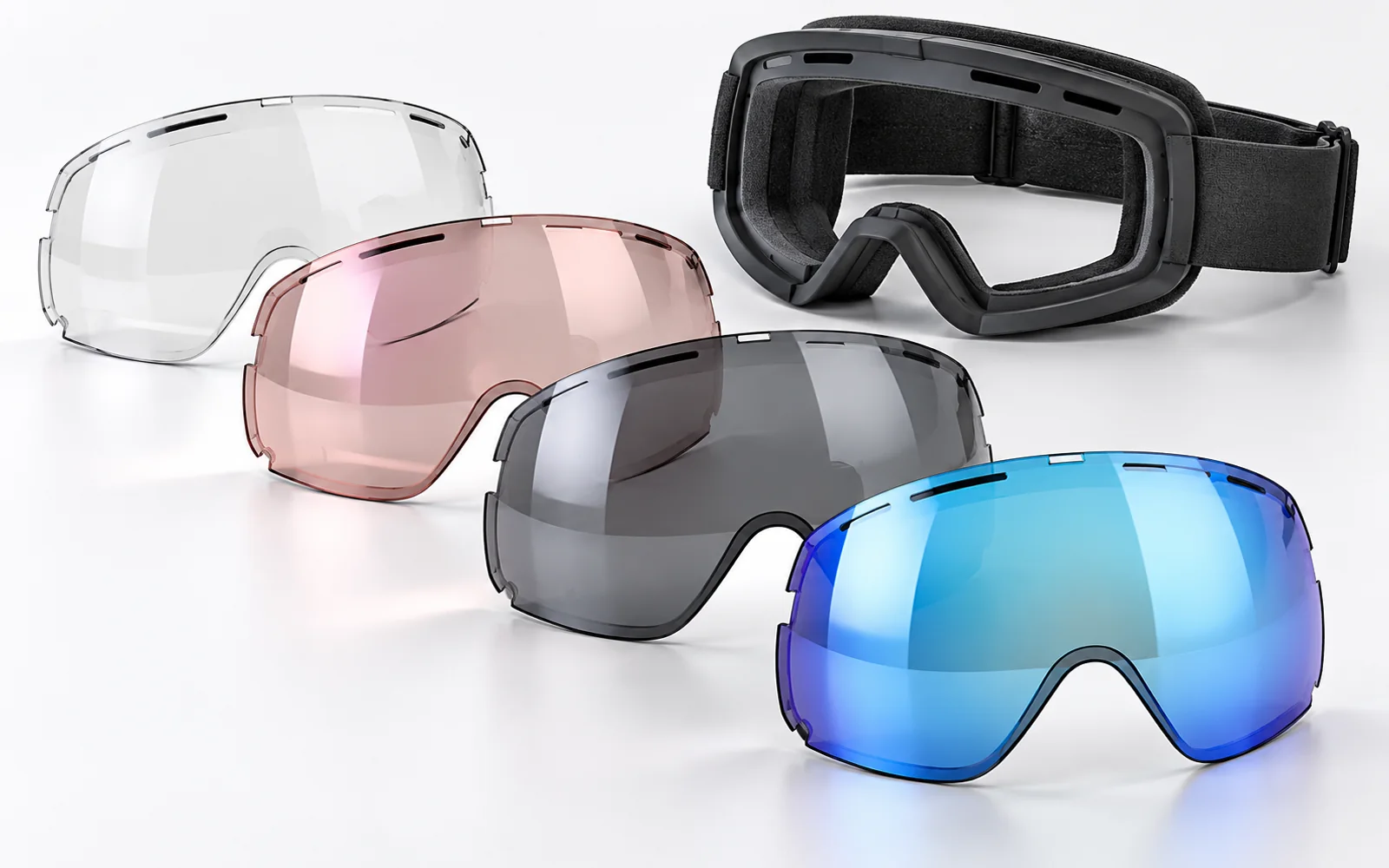
The base tint affects the colour balance the wearer sees. A reflective coating changes the lens appearance and can also affect transmission. Specify both, then request results for the combination. A named mirror finish is not evidence of polarization, photochromism or a particular UV claim.
Darkness alone does not establish UV protection. Ask for the relevant finished-product evidence rather than inferring protection from category. For night use, obtain an explicit suitability statement for the exact lens and check its instructions; do not assume every S1 or S2 option is appropriate. Snow goggles are not driving eyewear, and S4 should not be proposed as a driving option.
Photochromic and Polarized Options
For a photochromic option, request the measured lightest and darkest states, test conditions and response behaviour of the finished lens assembly. Ask which temperature and activation conditions matter for that formulation. A declared category range describes the endpoints; transition behaviour needs separate consideration. Include the supplier’s use instructions in the sample review and confirm that the proposed lens suits your intended conditions.
For polarized options, request verification of polarization and assess the lens on its intended use. Julbo’s buying guide considers lens choices alongside fit and changing conditions. Compare representative samples in the intended goggle platform, record wearer feedback and practical handling, and keep the selected lens code with the purchase specification.
Construction and Coating Claims
Cylindrical, spherical and toric describe geometry, not an automatic optical-quality ranking. Evaluate the complete goggle for usable view, fit and optical performance. Double-lens construction, ventilation and an inner treatment can contribute to moisture management, but a construction description does not justify an unconditional fog-free claim.
Specify the inner anti-fog treatment separately from outer water-repellent or easy-clean coatings. Hydrophobic does not, by itself, prove anti-fog performance. Ask for the test method, acceptance criterion and care restrictions supporting each claim. Smith’s care guidance cautions against wiping a wet inner lens. Obtain the instructions for your own supplied treatment rather than assuming every coating is maintained identically.
Lens RFQ Checklist
- Identify frame, lens assembly, variant code and replacement compatibility.
- State target transmission, declared category and intended light conditions.
- Separate base tint, mirror finish and inner and outer treatments.
- Request finished-lens evidence for UV, optical and additional performance claims.
- For photochromic options, record endpoints and relevant test conditions.
- Agree measurement responsibilities, batch acceptance and change approval.
Maintain a variant matrix connecting each sales code to its evidence and instructions. If a mirror or tint changes, review coverage before reusing a category label or report. Ask separately about replacement-lens availability and packaging. Refer to ordering terms; the final quotation governs the agreed configuration, minimums and timing.
Sources & Further Reading
- ISO 18527-1:2021: snow-goggle standard scope
- SIST public ISO 18527-1:2021 preview: clause 5.2 and Table 1
- Julbo: ski-goggle selection, lenses, construction and fit
- Smith Optics: moisture management and inner-lens care
Sources checked for this editorial update. Standards and market requirements can change; confirm the applicable edition and product-specific evidence before placing an order.